What AI in CCTV Actually Means
The phrase AI surveillance covers a wide range of technologies, some of which are genuine artificial intelligence and some of which are not. For this article, AI in CCTV refers to deep learning-based video analytics: software that uses neural networks trained on large datasets to classify what it sees in a camera feed. The output is a structured description of the scene, such as a person at coordinates X and Y wearing a hard hat, or a vehicle of type truck at the gate.
This is meaningfully different from traditional motion detection, which only knows whether pixels in the frame have changed. Motion detection cannot tell a person from a flag blowing in the wind, which is why traditional CCTV systems generate large numbers of false alarms. AI systems can, with the right training data.
How AI Surveillance Differs from Traditional CCTV
Six core capabilities show the practical difference between traditional CCTV and AI-enabled CCTV in oil and gas environments.
Event detection
- Traditional CCTV: Pixel motion only.
- AI-Enabled CCTV: Object classification (person, vehicle, animal).
False alarm rate
- Traditional CCTV: High (weather, lighting, wildlife).
- AI-Enabled CCTV: Low after tuning.
Operator workload
- Traditional CCTV: Continuous monitoring required.
- AI-Enabled CCTV: Alert based, exception driven.
Forensic search
- Traditional CCTV: Manual review of footage.
- AI-Enabled CCTV: Searchable by object, time, attribute.
Response time
- Traditional CCTV: Operator dependent.
- AI-Enabled CCTV: Sub-second for trained events.
Hardware demand
- Traditional CCTV: Modest on cameras, heavy on central server.
- AI-Enabled CCTV: Moderate on edge cameras.
Practical Use Cases in Oil and Gas
PPE Compliance Monitoring
AI cameras at refinery entry points and process area boundaries can verify that workers entering are wearing the required hard hats, safety glasses, high-visibility clothing, and hearing protection. The system can be configured to alert a supervisor, lock a turnstile, or simply log the event for safety audit purposes. Detection accuracy for well-trained PPE models can exceed 95 percent in good lighting.
Perimeter Intrusion with Object Classification
A traditional perimeter camera triggers an alarm for any motion at the fence line. An AI camera triggers only when the motion is classified as a person or vehicle. The result is fewer nuisance alarms from blowing debris, animals, or rain, which makes the security team more responsive when a real alarm comes in.
Hot Work Permit Area Monitoring
Hot work permits require continuous observation of the work area by a fire watch. AI cameras can supplement (not replace) the fire watch by detecting flame, smoke, and unauthorised personnel entering the permit area. This is particularly useful for permits that run for many hours, where operator fatigue is a real risk.
Dropped Object and Restricted Zone Detection
On drilling rigs and offshore platforms, certain zones below crane lifts or above pipe racks are designated restricted zones. AI cameras can detect when a person enters one of these zones during a lift, providing a layer of warning that traditional cameras cannot.
Forensic Search
After an incident, investigators traditionally have to scrub through hours of footage from multiple cameras. AI-enabled systems index every object that appears in every camera, with attributes such as time, location, clothing colour, and direction of movement. An investigator can query “show me all people wearing red coveralls who entered the north gate between 14:00 and 16:00” and get results in seconds.
Edge AI vs Centralised AI
AI workloads can run on the camera itself (edge AI) or on central servers. Edge AI is now common for the simpler classification tasks: person detection, vehicle detection, PPE checks. Central server AI is still preferred for more complex tasks like behavioural analysis or face matching against large databases. The two layers usually work together. For a deeper look at edge architectures, see the edge-based CCTV guide.
What Can Go Wrong with AI Surveillance
AI is not infallible, and AI surveillance has real failure modes that operators should understand before specifying it.
Training data bias is among the most common issues. A PPE detection model trained on a dataset of workers in temperate climate sites may struggle to detect hard hats correctly on workers wearing heavy hooded coats in arctic conditions. Operators should ask vendors what training data was used and what the documented accuracy is for conditions similar to the deployment site.
Adversarial conditions can fool AI models. Heavy rain, dense fog, glare, and certain camera angles can all cause classification errors. AI should be paired with traditional alarm logic as a safety net.
Privacy and regulatory compliance vary by jurisdiction. Facial recognition is restricted or banned in many regions. PPE detection that records workers continuously may require consultation with works councils or labour unions. The technology should be deployed with the legal and regulatory framework in mind from day one.
Hazardous Area Certification for AI Cameras
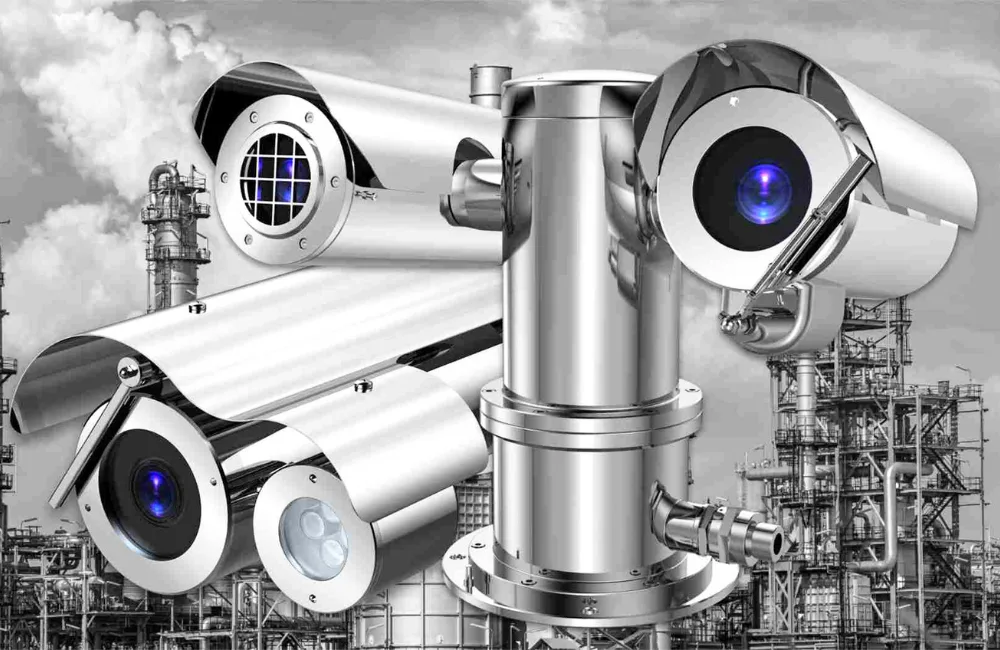
An AI camera in a Zone 1 or Zone 2 area still needs ATEX, IECEx, or Class I Division certification covering the complete unit. The AI capability does not change the certification requirement, but it can increase the power draw of the camera, which in turn affects thermal performance and the certification calculations. Bergen Security’s AI-enabled explosion-proof camera range lists models certified for hazardous areas.
AI in CCTV is now a practical tool for oil and gas operators, not a future technology. The right use cases (PPE compliance, perimeter intrusion with classification, forensic search) deliver measurable value today. The wrong use cases (complex behavioural prediction, mission critical safety detection without backup logic) still cause problems.
The key to a successful deployment is treating AI as one layer of a surveillance system, not the whole system. Pair AI cameras with traditional detection logic, plan for the failure modes, and start with use cases where the technology is mature.