Why Thermal Imaging Belongs in Oil and Gas Surveillance
Thermal cameras detect heat instead of light. They produce an image in complete darkness, see through smoke and most fog conditions, and reveal temperature differences that the human eye and standard cameras cannot. For oil and gas sites, where many hazards involve heat (or absence of expected heat), thermal imaging adds a layer of awareness beyond the reach of visible light cameras.
Common applications include gas leak detection, flare monitoring, pipeline hot spot identification, equipment condition monitoring, and nighttime perimeter surveillance. Each of these uses thermal imaging for different reasons, and each requires different camera specifications.
How Thermal Cameras Work
A thermal camera contains an array of microbolometer pixels. Each pixel responds to incoming long-wave infrared radiation by changing its electrical resistance. The camera measures that change and converts it into a temperature reading. The full array produces an image where each pixel value represents a temperature, not a brightness or colour.
Most industrial thermal cameras operate in the long-wave infrared band (LWIR), roughly 8 to 14 micrometres wavelength. A smaller category of specialised cameras operates in the mid-wave infrared band (MWIR), 3 to 5 micrometres. LWIR cameras are uncooled, smaller, and cheaper. MWIR cameras are cooled, more sensitive, and used mainly for high end gas detection and military applications.
Resolution and What It Means in Practice
Thermal camera resolution is much lower than visible light cameras. A 640 by 512-pixel thermal sensor is considered high-resolution. A 160 by 120 sensor is at the budget end. The reason is cost: each thermal pixel is far more expensive to manufacture than a visible light pixel.
Resolution affects how far away the camera can detect, recognise, and identify a target. Industry guidelines (Johnson criteria) suggest that detection of a person sized target requires the target to span about 1.5 pixels, recognition requires about 6 pixels, and identification requires about 12 pixels. A 640-resolution camera with a 25-millimetre lens can detect a person at around 1,200 metres and identify them at around 150 metres. A 160-resolution camera with the same lens detects at around 300 metres and cannot reliably identify at any useful distance.
NETD and Sensitivity
Noise Equivalent Temperature Difference (NETD) is the smallest temperature difference the camera can resolve. It is measured in millikelvin (mK). Lower numbers are better.
A general-purpose thermal camera typically has a NETD of around 50 to 60 mK. A high-sensitivity model used for gas leak detection or precision equipment monitoring runs at 30 mK or below. The practical difference is significant. At 60 mK, a slow methane leak in cold weather may not show against the background. At 30 mK, the same leak is clearly visible. For leak detection applications, NETD matters more than resolution.
Applications by Use Case
Gas Leak Detection
Hydrocarbon gas leaks absorb specific wavelengths of infrared radiation. Optical gas imaging (OGI) cameras are specialised thermal cameras tuned to those wavelengths. They produce an image where escaping gas appears as visible plumes, even when the gas itself is invisible to the human eye. Methane, propane, ethylene, and dozens of other industrial gases can be visualised this way.
OGI cameras have become standard equipment at refineries, gas processing plants, and pipeline compressor stations. For methane specific monitoring, see Bergen Security’s methane detection solutions.
Flare Monitoring
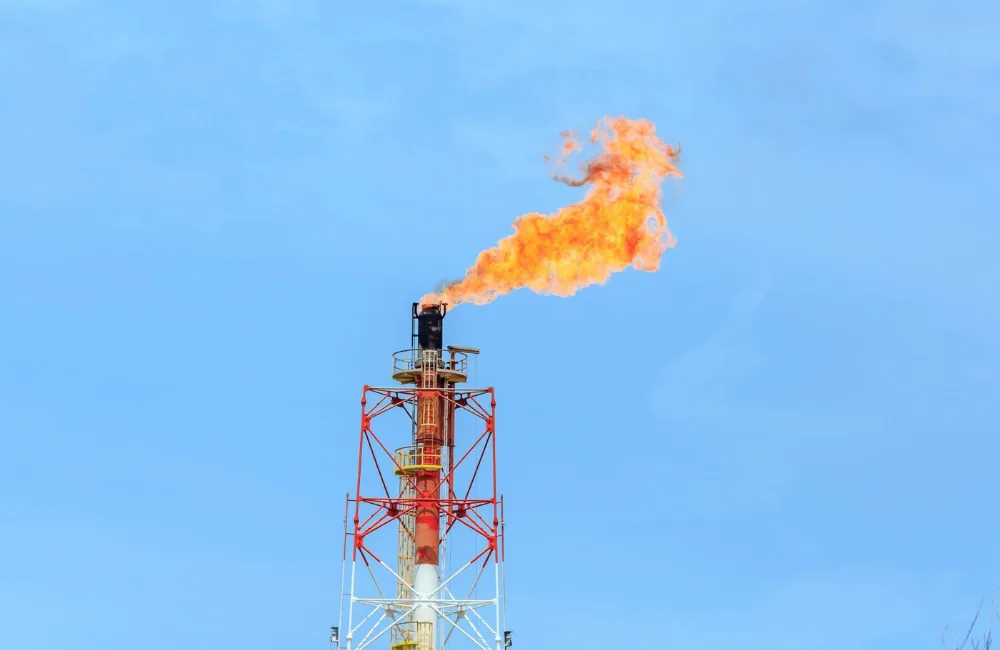
Flare stacks must operate within strict temperature ranges to ensure complete combustion. A flare burning too cool produces unburned hydrocarbons. A flare burning out altogether is a major environmental and safety incident. A thermal camera mounted to view the flare tip provides continuous temperature monitoring and triggers an alarm if the flame temperature falls outside acceptable bounds. See the flare monitoring application page for typical setups.
Pipeline and Equipment Hot Spots
Bearings that are starting to fail run hot. Valves that are partially blocked run hot. Insulation that is degraded shows cold spots on the outer surface. A scheduled thermal survey of plant equipment catches these problems weeks or months before they cause unplanned downtime. Fixed thermal cameras on critical assets provide continuous monitoring.
Perimeter at Night
Thermal cameras detect human presence at long range regardless of lighting conditions. They are not affected by glare from security lighting, do not need ambient light, and work through light fog and smoke. For long perimeters at remote sites, a thermal camera at every guard tower provides reliable intrusion detection, paired with a low-light or PTZ camera for identification once an intrusion is confirmed.
Hazardous Area Certification for Thermal Cameras
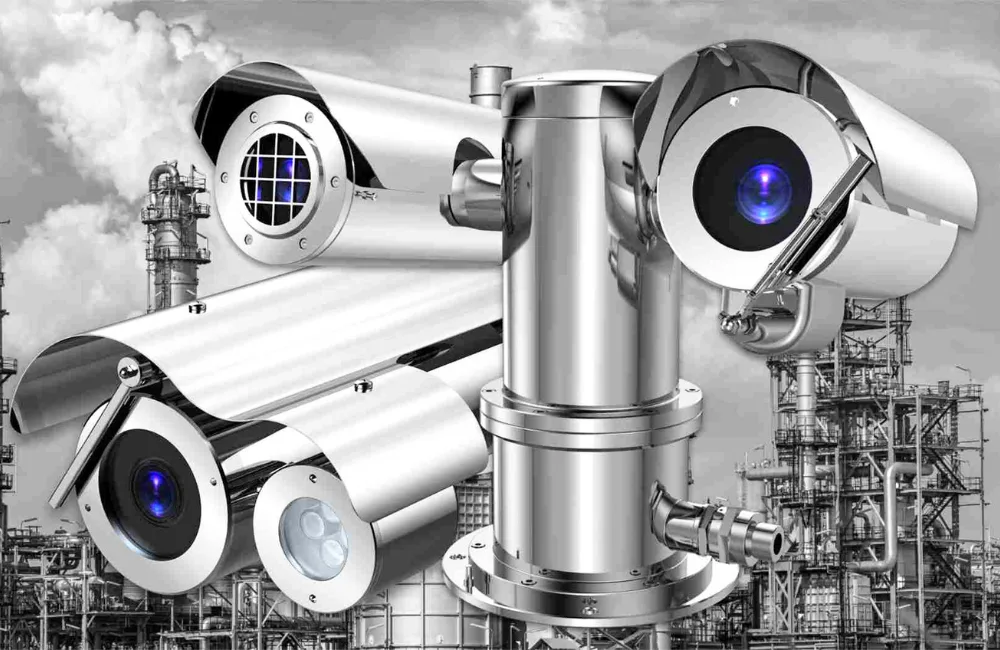
Thermal cameras installed in Zone 1 or Zone 2 areas must carry the same hazardous area certifications as visible light cameras. ATEX and IECEx are the international standards. The certification covers the complete unit, including the germanium window that admits infrared radiation. Germanium is transparent to LWIR but breaks under impact, so the window must be protected to maintain the ingress protection rating of the housing.
Bergen Security supplies thermal cameras certified for all common hazardous area classifications. See the thermal camera product range for available models.
Choosing the Right Thermal Camera
Several variables decide which thermal camera suits a given job. Resolution and lens combination follow from the target detection range, since a longer range needs more pixels on target. NETD reflects sensitivity, with lower figures needed for leak detection and higher figures acceptable for general monitoring. The temperature measurement range must match what the site produces, from cold backgrounds to flare heat. The wavelength band matters as well, with LWIR covering general use and MWIR reserved for specialised gas detection. As with any other camera in a classified area, hazardous area certification underpins all of it.
There is also a meaningful split between measurement and imaging. Some applications need accurate temperature readings and therefore a calibrated, measurement-grade camera, while others only need to see relative temperature differences and can rely on an imaging camera. Measurement-grade cameras cost considerably more and require regular calibration, so the distinction has a real bearing on both budget and maintenance.
Thermal imaging is now a routine layer of oil and gas surveillance, not a specialist tool. The technology has matured, the cost has dropped, and the certifications are widely available. For any new project, thermal cameras should be considered at the perimeter, at the flare, at critical rotating equipment, and at process areas where gas leaks could occur.
The biggest mistake operators make is choosing thermal cameras on resolution alone. NNETD, lens selection, and certification matter as much, sometimes more, for industrial applications. A 160-resolution camera with a good lens and 30 mK NETD outperforms a 640-resolution camera with the wrong lens and 60 mK NETD for most oil and gas use cases.